1 May 2026 · 4 min read
Post #1AI development is addictive
686,804 data points in my database before 11 AM. And the honest truth is: I just wanted to keep going.
686,804 data points in my database. Four minutes and 55 seconds for the data ingest itself. Three new ADRs documented. One blog post in the pipeline. Before 11 AM.
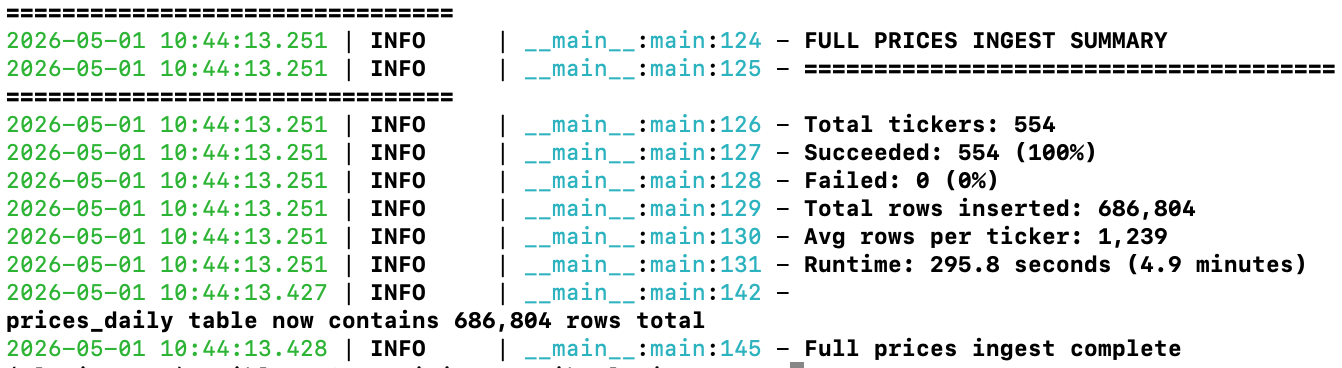
That's what happened today. And the honest truth is: I just wanted to keep going. Not because the work needed to be done, but because it feels so good to keep going.
AI development is addictive. And I think I need to explain why.
Reason 1: it's much faster than you think
I've ingested data via APIs before. At Kadenza, years ago, but also in personal experiments since. It was always the same pattern. Read documentation. Not understand what's meant. Write code. Error message. Pull up documentation again. Stack Overflow. Adjust code. Different error message. Half a day later, one endpoint works. Then the data format turns out different than expected. Etc.
Today: idea, prompt, click. Idea, prompt, click. Working pipeline within two hours. Scales to 554 companies with a single parameter change. Sends data straight to Supabase with conflict handling I didn't have to write myself.
The feeling: the distance between "I have an idea" and "it works" went from days to minutes.
Reason 2: problems get solved very quickly
Today I ran into four different problems. Validation failed on wrong field names in a Pydantic model. Foreign key constraint blocked a DELETE. Ticker convention between IEX and FMP didn't match. Three companies turned out to not even be primarily listed on Amsterdam.
Previously each of these problems would easily have taken an hour or two. Today combined: minutes.
Not because AI magically gives the right answer. But because we do it TOGETHER. I paste the error message, it thinks along, asks follow-up questions, makes a diagnosis, I test, it adjusts. Bam, bam, bam. One after another.
The search skill has shifted. I no longer search Stack Overflow for "PostgreSQL foreign key error 23503". I just brainstorm with someone who has already read everything.
Reason 3: it's instant gratification
This is the part where it really gets addictive.
Idea, prompt, click. Works. Another idea, prompt, click. Works. Decision? Click, documented in DECISIONS.md. Next step? Click, in TODO.md. Lesson? Click, in LESSONS_LEARNED.md.
Next step, step 2, step 3, all structured and stacked on top of each other. Boom, boom, boom, boom.
Every 5 or 10 minutes you have a new win. A script that runs. A test that passes. An ADR that stands. The brain gets constant small dopamine hits. And those hits are real: there is genuine progress. You're not scrolling Instagram, you're building a trading system.
But the same mechanisms are at work. The feedback loop is short. Reward is direct. And you want to keep going.
Honest about the shadow side
It's no coincidence I'm deciding to write this at the end of an exceptionally productive morning. In moments like these I'm in flow, I feel powerful, everything works, and I want to keep going. It's tempting to think: just one more step, then I'll stop. And one more. And one more.
Three counterforces I use deliberately:
One: fixed session rituals. At the start a kickoff (where are we), at the end a closeout (what did we do, what's next). The closeout forces me to consciously close out instead of starting another prompt.
Two: the six-eyes principle. I don't write code myself. Cursor generates, Claude/Harry reviews, I check and commit. Three perspectives. That tempers speed where needed: for an ADR about dividend-adjusted close we took 30 minutes to find the right rationale, not 5 minutes to lock something down quickly.
Three: documentation as a brake. DECISIONS.md, NOTES.md, BLOG_CONTENT.md. Writing forces thinking. When I can't articulate a choice, I know I was moving too fast.
What this means for others
If you're not yet building AI-supported, do it. The productivity gain is not 20 percent. It's more like an order of magnitude. But be warned: the feedback loop is so short it becomes addictive.
Build rituals for closing out. Build structure that forces thinking. Work with someone who can stop you when you go into tunnel vision.
And enjoy the gratification. Because yes, it's addictive. But it's also just incredibly fun.
Four minutes and 55 seconds for 686,804 data points. Before 11 AM. With a blog post that almost wrote itself during lunch.
Click.